
Biohacking
Biohacking for Operators: The Complete 5-System Guide
A biohacking framework for operators: sleep, metabolic tracking, biomarkers, supplements, and recovery tech run as one measured system, not a 40-item protocol.
Most biohacking content is a shopping list. This guide is an operating model instead: five systems, one measurement loop, and a 90-day order of operations. It starts with the cheapest interventions and earns the expensive ones. I run my body the way I run a business. There is a baseline, one change at a time, and a number that has to move before anything stays.
Medical disclaimer. I am not a physician. Everything on this page is personal experimentation and general information, not medical advice. Talk to your doctor before you change a protocol, especially if you have a condition or take medication.
Bottom Line. (1) Biohacking, for an operator, is measurement plus one controlled change at a time. Without a baseline, every supplement and gadget is an unpriced expense. (2) Five systems cover almost everything worth doing: sleep, metabolic tracking, biomarkers, supplements, and wearables plus recovery tech. (3) The cheap, boring 20% does most of the work: a fixed wake time, protein, daily walking, sunlight, and a yearly blood panel. Sleep regularity alone tracked with a 30% lower all-cause mortality risk in about 61,000 adults. (4) Supplements and recovery tech come last. Creatine and magnesium have real but small effects; cold plunges have short-lived evidence. (5) Start with the 90-day sequence at the end of this page.
In this article:
- What biohacking means when you run it like an operator
- Why the loop matters more than any single intervention
- Map of this guide: every system and its pages
- System 1: Sleep is the balance sheet everything else posts to
- System 2: Nutrition and metabolic tracking, without the diet wars
- System 3: Biomarkers are the annual P&L review
- System 4: Supplements are the last line item, and a small one
- System 5: Wearables and recovery tech, accuracy before features
- The 20% that produces 80% of the result
- A 90-day starting sequence if none of this is in place
- What this guide does not cover, and what I do not know
- Questions operators ask
- Where to go next
What biohacking means when you run it like an operator
Biohacking is any deliberate, measured change to your own biology, tracked well enough that you can tell whether it worked. That definition is stricter than the popular one. The wellness-influencer version is a stack of protocols adopted on faith. The operator version is a series of small experiments, each with a control period and a written result.
The scale of the faith-based version is large. The Council for Responsible Nutrition, the supplement industry's trade group, surveyed 3,194 U.S. adults in 2024 and found 75% took dietary supplements (CRN, 2024, retrieved 2026-09-05). Median spend was $50 a month, and energy was the stated reason for 27% of users. At the same time, 30.5% of U.S. adults slept less than seven hours a night in 2024 (CDC/NCHS Data Brief 559, 2024 data, retrieved 2026-09-05). A lot of people are buying energy in a capsule while leaving the free version on the table.
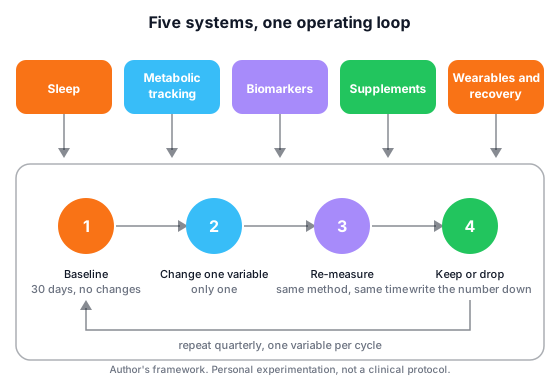
The framework I use has five systems and one loop. The systems are sleep, nutrition and metabolic tracking, biomarkers, supplements, and wearables plus recovery tech. The loop is the same for each. Hold a 30-day baseline, change one variable, re-measure with the same method at the same time of day, then keep or drop it. It is the P&L discipline applied to a body.
Two things this guide is not. It is not a longevity protocol with a dozen compounds and a founder selling them. And it is not a clinical resource; the top-ranking definitional pages from hospital systems already do that job well. This is the practitioner's layer that sits between the two.
Why the loop matters more than any single intervention
The strongest data point in this whole cluster is not a supplement. It is the regularity of your sleep timing. A UK Biobank analysis tracked about 61,000 adults with wrist accelerometers for a week and followed them for years. The most regular sleepers had a 30% lower all-cause mortality risk than the least regular fifth, and a 38% lower cardiometabolic mortality risk. Regularity fit the mortality data better than sleep duration did (Sleep editorial on Windred et al., 2024, retrieved 2026-09-05). That is observational, so it is an association, not proof. But it is a free variable that almost nobody tracks.
Why this matters for an operator specifically: the cost of poor recovery shows up in decision quality before it shows up in a lab value. A 2025 scoping review of sleep deprivation and decision-making found reduced decision-making ability in both surgeons and sports officials under sleep loss (PMC, 2025, retrieved 2026-09-05). If you make a handful of expensive decisions a week, that is the line item to protect.
The loop also protects you from the second most common mistake: changing five things at once. If sleep, creatine, a CGM, and a new training block all start the same week, nothing can be attributed. One variable per 30-day cycle feels slow. It is the only pace at which a result can be attributed to its cause.
Map of this guide: every system and its pages
This pillar links to seventeen deeper pages. Each system below has a summary here and a full treatment in its own cluster.
Sleep
- Sleep Optimization: The Framework, Not Another Sleep Hygiene Checklist
- How to Sleep Better at Night, Naturally: A Step-by-Step Protocol
- Natural Sleep Aids, Graded by Evidence (Not by Marketing)
Nutrition and metabolic tracking
- Continuous Glucose Monitors for Non-Diabetics: What They Actually Tell You
- B12 for Energy: When It Actually Helps
- The Supplement Stack for Focus and Energy That Isn't Just Caffeine
Biomarkers
- Biological Age Tests: Which Ones Are Worth the Money
- Blood Biomarker Testing: The Panel Worth Running Once a Year
- At-Home Hormone Test Kits: What They Get Right and Where They Fall Short
Supplements
- Nootropics for Focus, Graded by Evidence
- The Best Supplements for Energy, Ranked by Evidence and Cost
- Creatine for Energy and Focus, Not Just the Gym
- Magnesium for Energy: The Form Matters More Than the Dose
Wearables and recovery tech
- Oura vs. Whoop: Which One Actually Changes What You Do
- How to Actually Use HRV Tracking
- The Best Sleep Trackers, Ranked for Accuracy Over Features
- Cold Plunge Benefits: What's Real, What's Overstated
System 1: Sleep is the balance sheet everything else posts to
Sleep is the first system because every other measurement is contaminated without it. Glucose, HRV, resting heart rate, and reaction time all move with a bad night. Fix the timing first, or you will spend the next quarter chasing noise.
My approach to sleep optimization is a framework, not a hygiene checklist. The framework has three levers, in order of evidence. First, a fixed wake time seven days a week. Second, morning outdoor light within an hour of waking. Third, a caffeine cutoff in the early afternoon. The regularity data above is why the wake time comes first. Duration still matters, but the cohort data suggests consistency of timing carries more weight than duration alone.
Only after the timing is stable do I look at the softer variables: room temperature, alcohol, late meals, and screens. The step-by-step version of that sequence is my guide on how to sleep better at night naturally, including what to change in which week.
Supplements come last in this system too. Magnesium, glycine, and melatonin each have some trial evidence, and each has a marketing budget far larger than the effect. My grading of which is the strongest natural sleep aid goes by trial quality rather than by popularity. Honest summary: none of them substitutes for a fixed wake time.
Personal data. My own baseline, tracked on a Whoop worn continuously since 2023: sleep performance sits at 70-83% most nights against Whoop's own >85% optimal threshold, and sleep debt is frequently at or near the app's maximum trackable figure (~127 minutes). Recovery and HRV visibly dip on the nights that run worst. I have not yet completed a controlled before/after test of a fixed wake time — that specific experiment is in progress and detailed, mid-run, in how to sleep better naturally. This is the honest starting point, not the result.
System 2: Nutrition and metabolic tracking, without the diet wars
The metabolic system is where the most money is wasted per unit of evidence. The two questions worth asking are simple: is my glucose behaving normally, and am I actually deficient in anything before I supplement it?
On the first question, a continuous glucose monitor for non-diabetic users is a genuinely useful two-week experiment and a poor permanent habit. A 2025 systematic review found only seven qualifying studies, about 1,127 participants in total, and mostly short interventions. The clearest practical finding was timing. A walk started about 20 minutes before a person's usual post-meal glucose peak cut the insulin response by 28.7% (Cureus systematic review, 2025, retrieved 2026-09-05). The same review noted that direct evidence on blood pressure or lipids was rarely reported. A CGM tells you when to walk. It does not tell you that you are healthier.
On the second question, the B12 story is instructive. Roughly 3.6% of U.S. adults are B12 deficient by serum level (NIH Office of Dietary Supplements, NHANES 2007-2018 data, retrieved 2026-09-05). For the other 96%, the evidence is thin. A meta-analysis of randomized trials found supplementation likely ineffective for cognition or mood in people without deficiency (PMC, 2021, retrieved 2026-09-05). The fatigue trials were too small to support the claim. I break down who actually benefits from vitamin B12 supplements for energy in the dedicated post. Test first, then decide.
The nutrition-side stack I consider reasonable is short: a protein target, hydration, and a few compounds with trial support. My short list of supplements for focus and energy is deliberately brief, and caffeine is not the centerpiece.
System 3: Biomarkers are the annual P&L review
A blood panel is the closest thing biology has to a financial statement. Read once, it is a data point. Read once a year against the previous year, it is a trend, and trends are the only thing worth acting on.
The panel I run and why each marker earns its place is in my guide to blood biomarker testing. One marker illustrates the whole logic: apolipoprotein B. Standard panels report LDL cholesterol, but apoB counts the actual number of atherogenic particles. In 8% to 23% of people the two disagree, and in the discordant group only apoB predicted cardiovascular risk (adjusted hazard ratio 1.23) (Circulation review, 2024, retrieved 2026-09-05). Asking for apoB costs a few dollars extra and removes a blind spot. That is the kind of trade an operator should recognize.
Biological age tests are the flashier product in this category and the harder one to justify. In the largest independent comparison to date, 14 epigenetic clocks were tested against 174 disease outcomes over ten years in 18,859 adults. Second- and third-generation clocks such as GrimAge and DunedinPACE predicted disease onset far better than first-generation clocks (Nature Communications, 2025, retrieved 2026-09-05). Many consumer kits still use the older generation. Which clock you are buying matters more than the brand on the box. My cost-benefit read on which biological age test is worth the money lands on "maybe, once, for a trend" rather than a yes.
Hormone testing at home sits in between. Finger-prick and saliva kits are convenient and, for some hormones, reasonably informative. For others, the timing and the assay make the result hard to interpret. I compare the main at-home hormone test kits one by one, including which results I would only trust from a venous draw.
Personal data — pending measurement. This section will carry my own annual panel: the markers I run, the lab, two consecutive years of values for at least apoB, fasting glucose or HbA1c, and ferritin, plus what changed between draws and what I did not control. Not filled in yet; I publish it once measured, not before.
System 4: Supplements are the last line item, and a small one
Supplements come fourth because their effect sizes are small next to the first three systems. That is not a reason to skip them. It is a reason to size the position correctly.
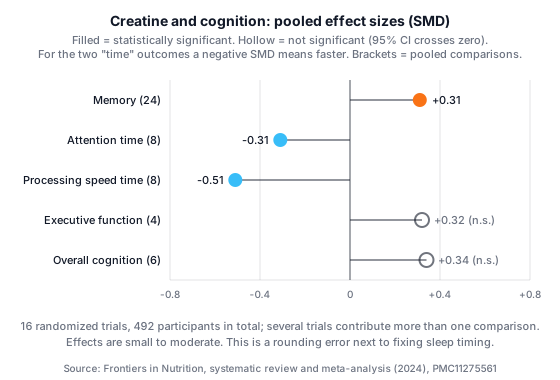
Creatine is the best-evidenced example. A 2024 meta-analysis pooled 16 randomized trials with 492 participants, with several trials contributing more than one comparison (Frontiers in Nutrition, 2024, retrieved 2026-09-05). Memory improved significantly (SMD 0.31) and processing speed got faster (SMD -0.51). SMD is the standardized mean difference, a unit-free effect size where 0.2 counts as small and 0.5 as moderate. Overall cognition and executive function did not move significantly. Small to moderate effects, cheap compound, decades of safety data. I cover the dosing, the sleep-deprivation angle, and the one common side effect in the creatine supplements for energy write-up.
Magnesium is the second compound with real trial data and a form problem. Use among supplement takers rose to 23% in 2024 (CRN, 2024, retrieved 2026-09-05), and the form on the label matters as much as the dose. A 2026 randomized trial gave 100 adults with poor sleep either placebo or 2 grams a day of magnesium L-threonate for six weeks. The magnesium group improved more on a sleep-impairment score and a cognition composite. The trial was funded by the compound's manufacturer, which is the caveat I would attach to it (Frontiers in Nutrition, 2026, retrieved 2026-09-05). Form, dose, and the funding question are all in the magnesium supplements for energy breakdown.
Beyond those two, the field gets thin quickly. My ranking of the best supplements for energy, by evidence and by cost per effective dose, covers the rest. The nootropics for focus category gets its own evidence grading. It runs from caffeine and L-theanine down to compounds with one small trial and a large Reddit following.
The rule for every supplement is the loop itself. One compound at a time, a 30-day window, a pre-specified outcome measure, and a written verdict. If I cannot name the number it is supposed to move, I do not buy it.
Personal data. My current stack: creatine (10 g/day), magnesium bisglycinate, zinc, B12, omega-3, citrulline malate, protein powder, EAA, and collagen occasionally — roughly €100/month combined. I have not yet run a formal one-variable-at-a-time outcome test on each compound against a pre-specified metric, which is exactly the loop this section argues for. That audit — cost per compound, the metric it's supposed to move, and what gets cut if it doesn't — is next, and I'll publish the real result once it's run, not a plausible-sounding one now.
System 5: Wearables and recovery tech, accuracy before features
Wearables are the most visible part of biohacking and the most misused. The device is not the intervention. It is the measurement instrument for the other four systems, and it is only as useful as its accuracy on the metric you care about.
The accuracy picture is clear and specific. A 2024 hospital study tested 35 healthy adults against polysomnography, the lab standard. The Oura Ring Gen3, Fitbit Sense 2, and Apple Watch Series 8 all detected sleep versus wake with at least 95% sensitivity. All three also landed within about 10 minutes of the lab on total sleep time. Sleep staging was another matter. Sensitivity by stage ranged from 76.0% to 79.5% for the Oura Ring and from 50.5% to 86.1% for the Apple Watch (Sensors, 2024, retrieved 2026-09-05). A 2025 study put six wrist devices on 62 adults. Most differed significantly from the lab on sleep efficiency and wake after sleep onset. Whoop 4.0 overestimated deep sleep by about 31 minutes (Sleep Advances, 2025, retrieved 2026-09-05).
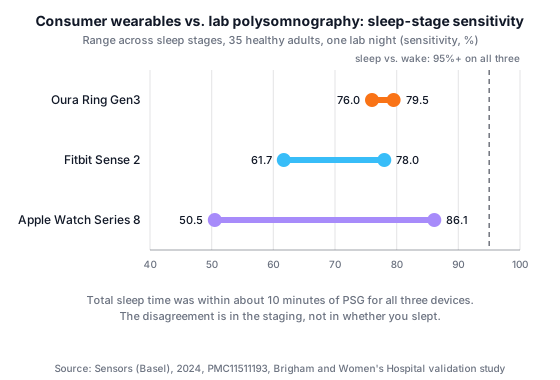
The operator's takeaway: trust total sleep time and timing, and treat the stage breakdown as an estimate. Never change a protocol because "deep sleep" moved by ten minutes. That principle drives my ranking of the best sleep tracker options. It also drives the Oura vs Whoop head-to-head, which is less about sensors than about which one changes your behavior.
Heart rate variability is the metric most worth learning to read and most often misread. A meta-analysis of HRV-guided training found it superior to fixed programs for improving vagal HRV indices, though not resting heart rate (PMC, 2021, retrieved 2026-09-05). The value is in the weekly trend against your own baseline, not in the morning number. My approach to HRV tracking as a load-management input is spelled out separately.
Recovery tech deserves the most skepticism. A 2025 meta-analysis of cold-water immersion covered 11 studies and 3,177 participants (PLOS ONE, 2025, retrieved 2026-09-05). Inflammation rose immediately and one hour after immersion. Stress was lower at 12 hours. There was no consistent benefit for mood or immune function. Sleep quality and wellbeing showed promise with wide variation across protocols. That is a "pleasant, possibly useful, not transformative" verdict, and I separate the real cold plunge benefits from the overstated ones in that review.
Personal data. My own baseline, Whoop, worn continuously since 2023 (recent two-week window): resting heart rate 60-65 bpm, HRV 34-48 ms, blood oxygen 94-98%, skin temperature stable at 33.5-34.5°C. All in normal range for an athlete my age, with recovery swinging widely (roughly 40-90%) in step with training load, not with any sleep-timing intervention yet — that comparison is future work, tracked in HRV tracking for recovery.
The 20% that produces 80% of the result
If this whole guide collapsed to one list, it would be this one. Every item is cheap, boring, and better evidenced than almost anything sold as biohacking. Each entry states its money cost, its time cost with the unit, and what the evidence actually supports.
- Fixed wake time, seven days. Cost: zero. Time: zero. Effect: regularity tracked with 30% lower all-cause mortality in the cohort data above; the likely mechanism is circadian, and it also makes every other measurement cleaner.
- Morning outdoor light. Cost: zero. Time: 10 to 20 minutes a day. Effect: anchors the circadian rhythm that the wake time sets; the evidence is mechanistic and consistent rather than from large trials.
- Daily walking, especially after meals. Cost: zero. Time: 20 to 30 minutes a day. Effect: the CGM literature's clearest finding, a 28.7% lower insulin response when the walk precedes the glucose peak.
- Protein at every meal. Cost: modest. Time: none beyond planning. Effect: supports muscle retention and satiety; this is basic nutrition, not a hack, which is the point.
- A once-a-year blood panel with apoB. Cost: roughly the price of a good dinner, depending on country and insurance. Time: one hour a year. Effect: turns a data point into a trend and closes the LDL blind spot.
- Creatine, a standard daily maintenance dose. Cost: a few dollars a month. Time: none. Effect: small, significant improvements in memory and processing speed in the pooled trials.
Everything else in this cluster is optional and should be priced as such. That includes the ring, the CGM, the cold tub, and the biological age kit.
A 90-day starting sequence if none of this is in place
Start tomorrow morning with a fixed wake time. That is the whole first step, and it costs nothing. The rest of the sequence adds one measured variable per month so that each result can be attributed.
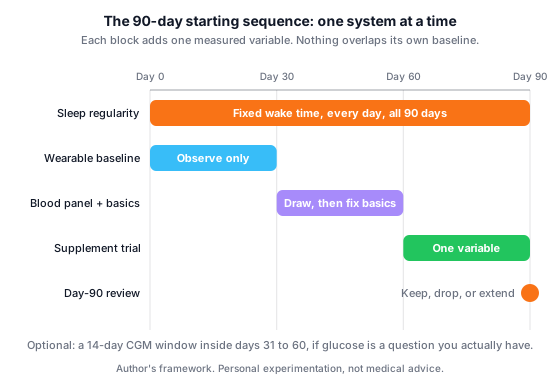
- Days 1 to 30: sleep timing and a baseline. Fix the wake time, get outside in the morning, and cut caffeine after early afternoon. If you own a wearable, wear it and do nothing with the data yet. If you do not, a notebook with bedtime, wake time, and a 1-to-5 energy score works. The framework is in the sleep optimization page.
- Days 31 to 60: blood panel and the basics. Book the panel from the blood biomarker testing page in the first week, then fix protein and walking while you wait for results. If glucose is a question you actually have, run a 14-day CGM in this window and nothing else new.
- Days 61 to 90: one supplement trial. Pick one compound from the ranked list, usually creatine or a well-absorbed magnesium, with a pre-specified outcome and a 30-day window. Write the verdict on day 90.
- Day 90: review. Compare the month-three averages with the month-one baseline. Keep what moved a number, drop what did not, and choose the next single variable for the following quarter.
The most common hesitation is that this is too slow. It is slower than buying a stack. At the end of the year, though, you will know which of your expenses did anything, and the stack buyer will not.
What this guide does not cover, and what I do not know
This page is a research synthesis plus a framework. The statistics come from the cited trials, cohorts, and reviews, each linked with a retrieval date; none of them is my own data. The first-person results that belong in each system are marked with "Personal data" callouts. Three of the four now carry real measured values — device, duration, and what wasn't controlled, stated in the same breath. The fourth, the annual blood panel, is still genuinely pending and marked as such; I publish it once measured, not before.
Out of scope here: clinical conditions, medication interactions, and weight-loss diets as a category. Also out: any protocol I have not either read the evidence for or run myself. The cold-plunge, biological-age, and CGM literatures are all young and mostly short-term, and I have tried to say so wherever it applies. When the evidence changes, this page changes with it, and the change is logged on the corrections page linked below.
Questions operators ask
Is biohacking safe?
Most of it is as safe as the behavior it describes; a fixed wake time and a walk carry no risk. The risk sits in the supplement and device fringe: high-dose compounds, unregulated nootropics, and stacking many things at once. Consult a physician before starting anything with a pharmacological effect, and change one variable at a time so a problem can be traced.
How much does biohacking cost?
The effective core costs almost nothing beyond food. The first 30 days of the sequence above are free. A blood panel, a wearable, and a two-week CGM are the meaningful expenses, and each is optional. U.S. supplement users spend a median of $50 a month, per the 2024 CRN survey. Most of that is spent without a measured outcome.
Do I need a wearable to start?
No. A wearable makes the baseline easier and more precise. A notebook with bedtime, wake time, and a daily energy score still captures the two variables that matter most in month one. Buy the device after the habit exists, so you have something worth measuring.
Which is better, a CGM or a blood panel?
A blood panel, if you can only do one. It covers lipids, glucose control, iron, thyroid, and more in a single draw and can be repeated yearly for a trend. A CGM answers one narrow question over two weeks. Run it once inside month two if glucose is a real concern, then stop.
Are biological age tests worth it?
Rarely, and only as a repeated trend using a second- or third-generation clock. The 2025 comparison of 14 clocks showed the training objective of the clock determines most of its predictive value. A single reading from a first-generation clock tells you very little you can act on.
Which supplement actually works for energy?
None of them replaces sleep timing, and the ones with evidence are unglamorous. Creatine has pooled trial support for memory and processing speed. Well-absorbed magnesium has trial support in people with poor sleep. B12 works when you are deficient and does little otherwise, which is why testing comes before buying.
Where to go next
Fix the wake time first, then read the system that matches the question you have. If sleep is the question, start with the sleep optimization framework. If you want to know what your body is doing before you change anything, start with the annual blood panel. If you already own a ring or a band and want it to change behavior rather than decorate a dashboard, start with HRV tracking.
The whole cluster runs on one idea. Your body is a line on your balance sheet, and it deserves the same discipline as the rest of it. Measure, change one thing, measure again, and keep only what moved.
About this guide. Written by Nate Harmon, an operator and self-experimenter documenting personal protocols in biology for Peak Human Ops. Not a physician or a licensed adviser. Sources are tier 1 to 3 journals, government statistics, and peer-reviewed reviews, each linked inline with a retrieval date. Nothing on this page is sponsored, and there are no affiliate links on it. How this site is written and corrected is set out in the editorial policy and the corrections log. Who is behind it is on the about page, and you can contact me directly.