
Biohacking
B12 for Energy: When It Actually Helps (and When You're Just Buying Expensive Urine)
B12 supplements only raise energy if you're actually deficient. The test to run first, the cutoffs that matter, and what happens if you skip it.
Run a serum B12 and methylmalonic acid (MMA) panel before you buy anything. If both come back normal, a B12 supplement is not going to touch your energy, no matter what the bottle promises. This is the test to order, the cutoffs that decide the answer, and what B12 supplementation actually does when you don't need it.
Medical disclaimer. I am not a physician. This page is personal experimentation and general information, not medical advice. Fatigue has dozens of causes, some serious. Talk to your doctor before starting any supplement. This matters most if you take metformin or a proton pump inhibitor, or have a history of gastric surgery or autoimmune disease.
Bottom Line. (1) B12 supplements only restore energy in people who are actually deficient. Correcting a real deficiency can meaningfully help; topping off a normal level does not. (2) Deficiency prevalence is 2-3% in general US adults. It climbs sharply in specific groups: long-term metformin users, older adults with reduced stomach-acid absorption, and strict vegans. (3) The test to run is total serum B12 plus methylmalonic acid (MMA), not a supplement trial. Order MMA when the result lands in the 180-350 pg/mL gray zone. (4) Methylcobalamin appears to be retained better than cyanocobalamin, though both correct a confirmed deficiency. (5) Oral B12 works about as well as injections for most people, per the newest clinical review.
How B12 Actually Produces Energy
B12 is a cofactor, not a fuel source. It's required for two reactions: converting homocysteine back into methionine, and converting L-methylmalonyl-CoA into succinyl-CoA (StatPearls/NCBI Bookshelf, updated Sept. 2024). That second reaction feeds directly into the citric acid cycle, where cells generate ATP. When B12 is genuinely scarce, that second reaction backs up, methylmalonic acid accumulates in the blood, and red blood cell production falters. The resulting anemia is what actually produces the fatigue people associate with "low B12." No deficiency, no backup, no fatigue signal to fix.
This is the same test-before-you-spend discipline that runs the rest of biohacking for me. Find the actual bottleneck before buying a fix for one you might not have.
Who Is Actually Likely to Be Deficient
Absorbing B12 from food requires stomach acid to free it, then intrinsic factor, a stomach-produced protein, to carry it through the small intestine. Anything that interrupts either step raises deficiency risk. General US adult prevalence sits at 2-3% (American Family Physician, Sept. 2025), but that number is misleading for anyone in a higher-risk group.
Long-term metformin users test deficient at 19.1%, against 9.5% in a non-metformin comparison group in the same review. Metformin interferes with intrinsic-factor-dependent absorption in the gut. Proton pump inhibitor use raises risk too, with an odds ratio of 1.42 (American Family Physician, Sept. 2025). Suppressing stomach acid blocks the first step of the absorption process. Adults over 50 lose stomach-acid output gradually. About 10-30% develop enough absorption impairment to matter (Harvard T.H. Chan School of Public Health, The Nutrition Source, retrieved Sept. 2026). Strict vegans and vegetarians are the other reliable risk group. B12 occurs naturally only in animal foods. Stores typically run out after roughly three years without supplementation or fortified food (StatPearls/NCBI Bookshelf, updated Sept. 2024).
Groups worth testing proactively, even without symptoms:
- Long-term metformin users (19.1% deficient, per the same AAFP review)
- PPI users (odds ratio 1.42)
- Adults 50+ with reduced stomach acid
- Strict vegans and vegetarians
- Anyone with celiac disease, Crohn's disease, autoimmune gastritis, pernicious anemia, or a prior bariatric surgery (American Family Physician, Sept. 2025)
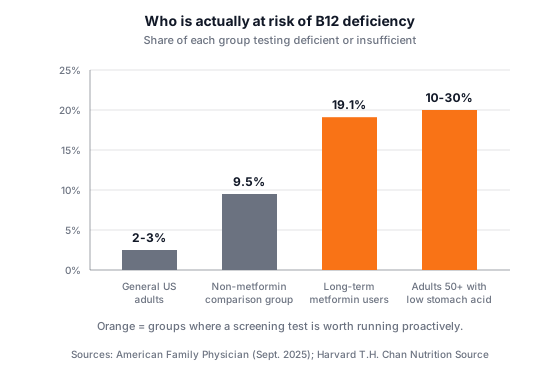
If none of those risk factors apply to you and you eat meat, eggs, or dairy regularly, deficiency is genuinely unlikely. That's not a reason to skip the test — it's a reason to expect it to come back clean.
The Test to Run Before You Supplement
Order total serum B12 first. A result under 180 pg/mL is deficient; above 350 pg/mL is normal (American Family Physician, Sept. 2025). The problem is the wide gray zone in between, roughly 180-350 pg/mL, where serum B12 alone can't tell you whether your cells are actually short. That's where a methylmalonic acid (MMA) test earns its cost: elevated MMA confirms a functional deficiency even when the serum number looks borderline-fine. Homocysteine is a secondary marker, but it also rises with folate deficiency, so it can't distinguish the two causes on its own (StatPearls/NCBI Bookshelf, updated Sept. 2024).
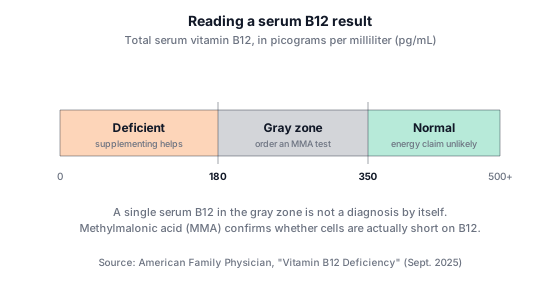
If you're already running an annual panel, this pair of tests is a rounding error to add. I cover the full panel worth running once a year, including where B12 and MMA fit relative to everything else, in blood biomarker testing.
Personal data — pending measurement. This section will carry my own serum B12 and MMA results, with both values shown. I'll draw both from the same lab panel and note the collection date. Not filled in yet; I publish it once measured, not before.
Dose and Form: Methylcobalamin vs. Cyanocobalamin
If a confirmed deficiency exists, the newest review found oral B12 supplementation "noninferior" to intramuscular injections for most people (American Family Physician, Sept. 2025). It reserves injections for severe deficiency or neurologic symptoms. The RDA for adults is 2.4 mcg daily from food (Harvard T.H. Chan School of Public Health, The Nutrition Source, retrieved Sept. 2026). Correcting an actual deficiency requires therapeutic doses far above that, set by whoever ordered your test.
Form matters more than most labels suggest. Cyanocobalamin, the cheap synthetic form in most multivitamins, needs an extra conversion step. It's also excreted in urine roughly three times faster than methylcobalamin, the form the body uses directly. That faster clearance means about 13% less ends up stored in the liver (Cureus, Nov. 2025). The review's authors recommend methylcobalamin over cyanocobalamin generally, and it matters more for anyone with methylation-pathway variants that slow the conversion. Sublingual and oral forms perform similarly at physiologic doses; the form of cobalamin matters more than the delivery route.
What Happens If You Supplement Without a Deficiency
Nothing measurable, and that's the honest answer. Harvard's Nutrition Source states it plainly: "there is no evidence of benefit if people without a deficiency take extra B vitamins." That's from the Harvard T.H. Chan School of Public Health, retrieved Sept. 2026. B12 is water-soluble, so a normal kidney clears the excess within a day or two — hence the "expensive urine" framing energy-supplement marketing never mentions. It's not dangerous at typical doses; it's just inert for anyone who wasn't short to begin with.
That inertness is exactly why the placebo effect does most of the work when non-deficient people report feeling more energetic after starting a B-complex. If you're chasing energy or focus and your B12 panel comes back clean, look elsewhere first. A continuous glucose monitor for non diabetic readers shows how meals move your energy in real time. For a broader stack with dose-response evidence behind it, see supplements for focus and energy.
Frequently Asked Questions
Can B12 supplements help energy even with a normal blood level? Not based on current evidence. Harvard's Nutrition Source and the clinical literature agree: benefit shows up only when a deficiency is corrected, not as a general energy boost above normal.
How long does it take to feel a difference after correcting a real deficiency? Symptom response varies by severity and cause. Neurologic symptoms can take months to resolve fully, so this is a question for whoever manages your treatment, not a fixed timeline.
Is a multivitamin's B12 dose enough if I'm actually deficient? No. Multivitamin doses target maintenance in already-replete people. A confirmed deficiency needs a therapeutic dose set against your specific test results, not a standard label amount.
The pattern holds across every supplement I've tested rather than assumed. Test first, dose to the number, and stop pretending a normal result is a reason to keep buying. That's the same operating discipline covered across biohacking — spend where the data shows a gap, not where the marketing is loudest.
About this guide. Written by Nate Harmon, an operator and self-experimenter documenting personal protocols in biology for Peak Human Ops. Not a physician or a licensed adviser. Sources are tier 1 to 3 journals and peer-reviewed reviews, each linked inline with a retrieval date. Nothing on this page is sponsored, and there are no affiliate links on it. How this site is written and corrected is set out in the editorial policy and the corrections log. Who is behind it is on the about page, and you can contact me directly.