
Biohacking
How to Actually Use HRV Tracking (Most People Just Watch the Number)
A step-by-step approach to using HRV data to make a real decision — train, rest, or push — instead of just checking a score.
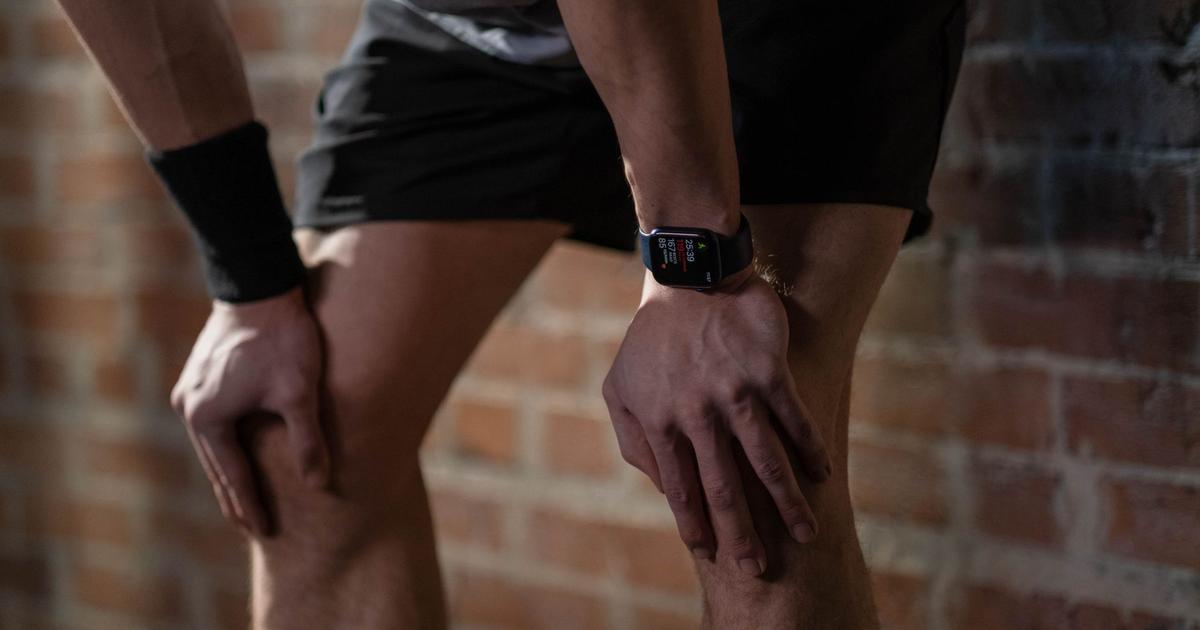
Most people open their wearable app, see a number, feel briefly good or bad about it, and change nothing. That's not HRV tracking. That's checking a score. The number only earns its place on your wrist if it changes what you do today. Train harder, back off, or protect sleep instead of pushing through it. This post is the operating manual for that decision, not another explainer of what the metric is.
Medical disclaimer. I am not a physician. This page is personal experimentation and general information, not medical advice. HRV tracking does not diagnose or treat any condition. Talk to your doctor before changing your training or health routine based on wearable data. That's especially true with an existing heart condition or a reading that looks persistently abnormal.
Bottom Line. (1) HRV is a decision input, not a score to optimize directly — there's no universal "good" number. (2) Population norms and age charts are close to useless for you personally; your own 7-14 day baseline is what matters. (3) A single day's dip is usually noise: day-to-day HRV swings 3-13% even in monitored athletes, and far more in everyone else. (4) Alcohol, illness, and travel move HRV more than most training does, so name the cause before you act on a low reading. (5) Act on a multi-day trend that has no obvious explanation, not on one bad morning.
What HRV Actually Measures
Heart rate variability is the millisecond-level variation in the time between consecutive heartbeats. It's a proxy for the balance between your sympathetic ("go") and parasympathetic ("rest and digest") nervous systems. A higher HRV generally reflects more parasympathetic influence at rest, which tracks loosely with recovery capacity. It is not a direct measurement of fatigue, sleep quality, or fitness, and it doesn't move in a straight line with any of them. It's an autonomic signal that recovery, training load, stress, and several unrelated variables all push on at once. That's exactly why reading it in isolation misleads people.
Step 1: Establish Your Own Baseline (Population Norms Are Close to Useless)
Skip the age-based "normal HRV" chart. A 2020 study tracked SDNN in 291 healthy adults (Frontiers in Aging Neuroscience, 2020, retrieved 2026-09-06). Mean values dropped from roughly 42 ms in men in their 20s to about 25 ms in men in their 60s. Standard deviations were wide enough that adjacent age brackets overlap almost completely. Genetics, fitness level, and how your specific device calculates the metric all shift where you personally land inside that range. A population number tells you almost nothing about whether your own reading today is good or bad.
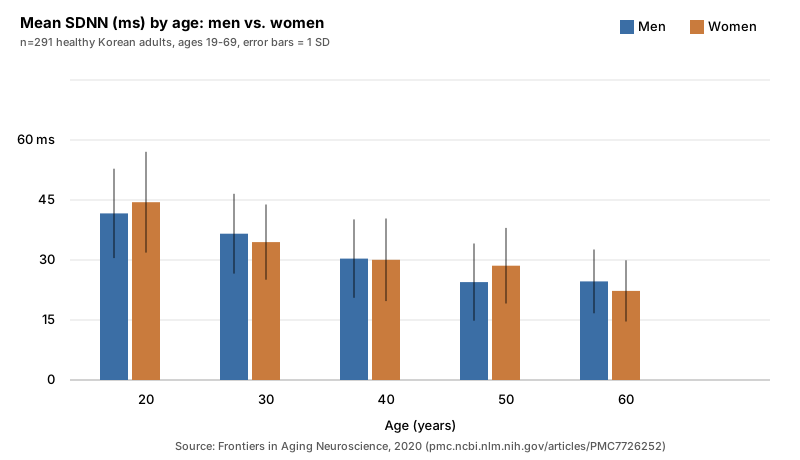
What matters is the trend against your own history. Log at least 7-14 consecutive mornings, same conditions each time (same wake window, same position, same device), before you treat any single number as meaningful. That rolling window becomes your baseline: the reference point every future reading gets compared against, not the chart above.
This is the same discipline that runs the rest of biohacking for me. Don't let a number change your behavior until you know what it's actually being compared to.
Step 2: The Decision Rule — What a Drop Should Actually Change
Most single-day HRV dips are statistical noise, not physiology telling you something. A 2025 observational study of 41 adults over 14 days found an average day-to-day coefficient of variation of 0.37 for RMSSD (Sensors, 2025, retrieved 2026-09-06). That means readings routinely swing 30-40% from a person's own mean with no external cause. The authors put it plainly: a single-day dip or rise often falls within your normal range and may not reflect a meaningful change. Even in 11 elite, closely monitored water polo players, weekly HRV variability still ran 3-13% (PMC, 2022, retrieved 2026-09-06). Trained athletes under lab-grade monitoring show that much natural noise. An untrained reader checking a phone app has no business treating one low morning as a verdict.
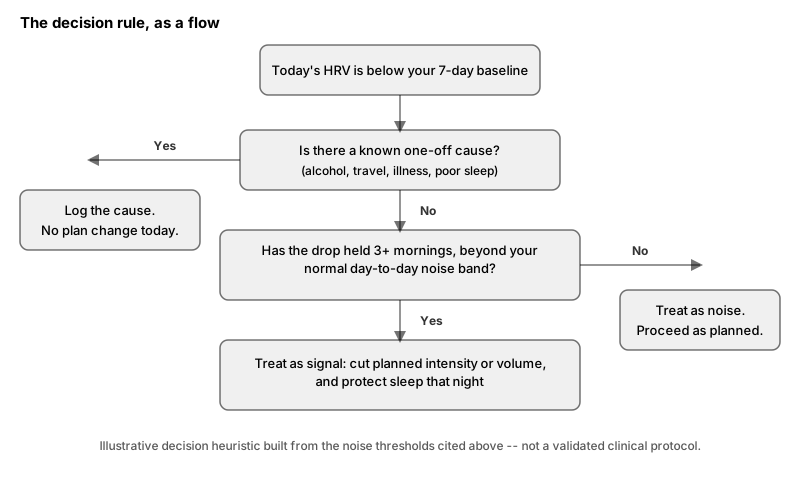
The rule I use: a single reading below my rolling baseline is noise until proven otherwise. I only change a decision when the drop holds for 3 or more consecutive mornings and exceeds the swing I've already seen on unremarkable days. One bad night doesn't touch training. A multi-day, unexplained slide does — usually a 20-30% cut to planned intensity or volume that day, not a full rest day.
Step 3: Control for the Variables That Swing HRV Besides Recovery
Before you credit or blame training for a reading, rule out the three confounders that move HRV more reliably than a hard workout does.
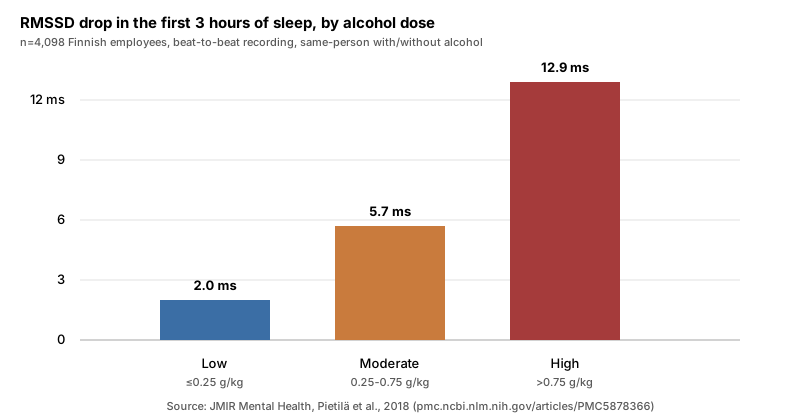
Alcohol. A study of 4,098 Finnish employees compared each person's own nights with and without alcohol (JMIR Mental Health, Pietilä et al., 2018, retrieved 2026-09-06). It found a dose-dependent RMSSD decrease in early sleep: 2.0 ms low, 5.7 ms moderate, 12.9 ms high. That's a same-night hit large enough to swamp anything your training did that day.
Illness. HRV changes are detectable in the window surrounding a COVID-19 diagnosis, including in people with no symptoms at the time. A 297-person healthcare-worker cohort found measurable shifts spanning roughly a week before and after diagnosis (JMIR, Mount Sinai cohort, 2021, retrieved 2026-09-06). If you're getting sick, your HRV can look "bad" days before you feel it. That's a legitimate rest signal, not a training-load problem.
Travel and circadian disruption. Crossing time zones desynchronizes your internal clock (Jet Lag: Current and Potential Therapies, PMC review, retrieved 2026-09-06). The resulting sleep disturbance can persist for several days on a large shift. It typically lasts longer after eastward flights than westward ones. Don't compare a jet-lagged morning to your home-timezone baseline and conclude anything about recovery.
Name the cause before you act. A low reading with an obvious explanation (you traveled, you drank, you feel a cold coming on) gets logged and ignored. A low reading with no explanation is the one that earns a change in plan.
What Nearly Three Years of My Own Data Shows
Personal data. I've worn a Whoop continuously since August 2023. My HRV baseline runs 34-48 ms, resting heart rate 60-65 bpm, with recovery swinging widely (roughly 40-90%) in step with training load rather than sitting flat. On top of that pattern, isolated single days show up every one to two months where recovery collapses to 1-3%, HRV drops to 7-26 ms, resting heart rate spikes to 70-92 bpm, and skin temperature rises well above my normal 33.5-34.5°C range, sometimes past 37°C. That combination — a real temperature signal alongside the HRV crash, not just a low number on its own — is exactly the "named cause" pattern above: it reads as an isolated illness or acute-stress event, not a training-load problem, and gets logged and left alone rather than triggering a program change. I haven't yet run the tighter version of this — tagging every alcohol/travel/illness day for 90 days and comparing my actual decisions against what the raw daily number alone would have told me to do. That's the next step, and I'll publish the real comparison once it exists.
The device you use for any of this matters less than whether you actually open it and apply the rule. I compare the two most common options in oura vs whoop. If sleep tracking accuracy is the deciding factor for you, I rank the field in best sleep tracker picks. On the intervention side, one of the more testable ways to see your own HRV respond to a controlled stimulus is a cold exposure protocol. I cover what that actually does and doesn't do in cold plunge benefits.
Is a higher HRV always better?
Not always, and not immediately. Higher HRV generally correlates with better recovery capacity at the population level. But the number that matters is whether your own reading is rising or falling relative to your baseline, not whether it beats someone else's. Extremely high single-day readings can also reflect measurement artifacts rather than better recovery.
How many days of data do I need before I trust my baseline?
At least 7 days for a rough baseline, 14 for a more stable one. Given the day-to-day noise documented above, fewer than 7 days of logging isn't enough to distinguish your normal range from a real shift.
Should I ignore my HRV score the morning after a hard workout?
No, but weight it correctly. A single post-training dip is expected and usually resolves within a day or two. Treat it the same as any other single-day reading: log it, don't act on it alone. Just watch whether it persists past the window your own training normally takes to recover from.
This is a decision tool, not a report card. The reading only earns its place on your wrist the day it changes what you actually do. Most days, the right response to a low number is to name the cause and move on, not to act on it at all.
About this guide. Written by Nate Harmon, an operator and self-experimenter documenting personal protocols in biology for Peak Human Ops. Not a physician or a licensed adviser. Sources are tier 1-3 peer-reviewed studies, each linked inline with a retrieval date. How this site is written and corrected is set out in the editorial policy and the corrections log. Who is behind it is on the about page, and you can contact me directly.