
Biohacking
Oura vs. Whoop: Which One Actually Changes What You Do
A head-to-head on Oura and Whoop for recovery tracking: accuracy, subscription cost, and which one you'll actually act on.
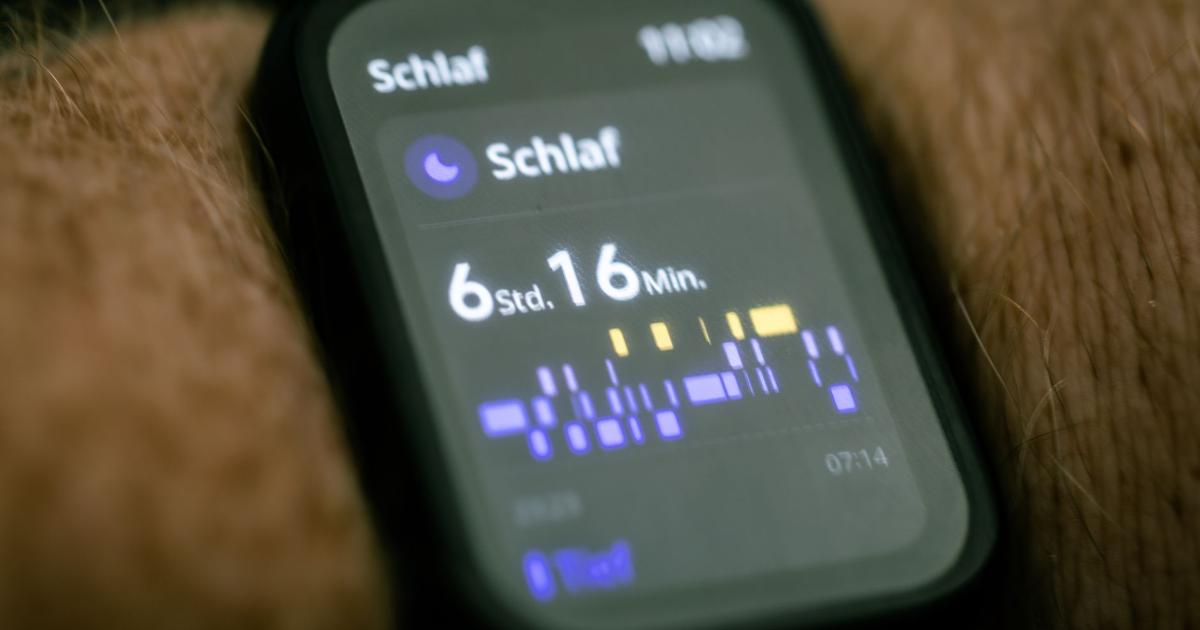
Oura and Whoop both promise the same thing: a number every morning that tells you whether to push or back off. They get there in almost opposite ways. One is a ring you forget you're wearing. The other is a wrist strap built around a training culture. Most comparisons stop at spec sheets. This one runs the actual decision: whose data you act on, and whose you quietly ignore after week three.
Medical disclaimer. I am not a physician. This page is personal experimentation and general information, not medical advice. Neither device diagnoses or treats any condition. Talk to your doctor before changing your training or sleep routine based on wearable data, especially with an existing heart or sleep condition.
Affiliate disclosure. This post may contain affiliate links to Oura and Whoop. If you buy through them, I may earn a commission at no extra cost to you. That has no effect on the comparison below. I report what the evidence and the pricing pages actually say.
Bottom Line. (1) Oura wins sleep-staging and nocturnal HRV accuracy in the one study that tested both devices directly. (2) Whoop wins training-load and strain data, because that's the metric it was built around. (3) Over 3 years, Oura is the cheaper option once you buy the ring outright. Whoop is cheaper in year one only. (4) The device that changes behavior is the one whose daily number you can explain in one sentence. (5) Buy Oura if sleep is the lever you're pulling. Buy Whoop if training load is.
What Each Device Is Actually Optimizing For
Oura is a sleep-first device wearing a recovery-score label. The ring's core sensors track temperature, HRV, blood oxygen, and movement overnight. The app's flagship metric is the Sleep Score, with a Readiness Score built downstream of that same sleep data (Oura Membership, retrieved 2026-09-06).
Whoop is a strain-first device wearing a recovery-score label. It tracks the same overnight signals but frames its output around Strain, a 0-21 scale meant to be read against Recovery before your next workout. Whoop's own tier pages describe One as covering "essential fitness, recovery, and sleep metrics." Peak and Life layer stress and health-screening tools on top of that same strain-and-recovery core (Engadget, 2026, retrieved 2026-09-06).
This is the same discipline that runs the rest of biohacking for me. Name what a number actually measures before you let it change your behavior. A Sleep Score and a Strain score answer different questions. Picking the wrong one for your goal is why so many people abandon either device by month three.
Accuracy: Where They Agree and Where They Diverge
Oura leads on nocturnal heart rate and HRV accuracy in the one study that tested both devices against the same ECG reference. A 2025 study in Physiological Reports ran 13 adults through 536 nights of sleep, a small but unusually data-dense sample. It compared Oura Gen 3, Oura Gen 4, Whoop 4.0, Garmin Fenix 6, and Polar Grit X Pro against a Polar H10 chest-strap ECG.
For resting heart rate, Oura Gen 4 scored a concordance correlation coefficient (CCC) of 0.98 with 1.94% mean error. Whoop 4.0 scored 0.91 CCC with 3.00% mean error. For HRV, Oura Gen 4 hit 0.99 CCC with 5.96% mean error (Physiological Reports, Dial et al., 2025, retrieved 2026-09-06). Whoop's HRV numbers were 0.94 CCC and 8.17% mean error in the same study. Both devices are usable. Oura is measurably closer to the medical-grade reference on both metrics.
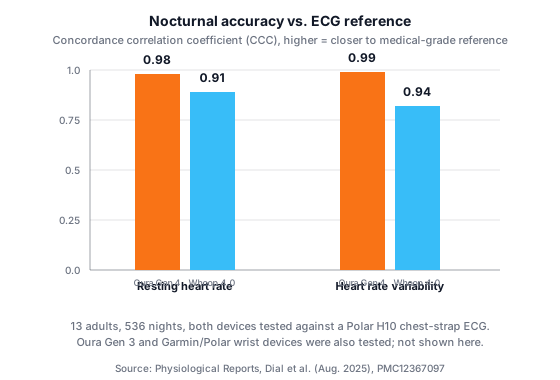
Where they converge is night-to-night trend detection. Both devices exist to catch a pattern over weeks, not to nail one night's number. A small nightly error matters less than whether the trend line stays honest. Past raw accuracy, the interface is where they diverge. Oura's ring form factor removes the strap-tightness and wrist-motion artifacts that periodically degrade any wrist-worn optical sensor. That's part of why the same study found Oura the more consistent performer across the full 536-night sample, not just on average.
If you're deciding how seriously to weight either device's HRV trend day to day, that's a separate skill from picking hardware. I cover how to read the number itself in hrv tracking.
Subscription Cost Over 3 Years, Honestly Compared
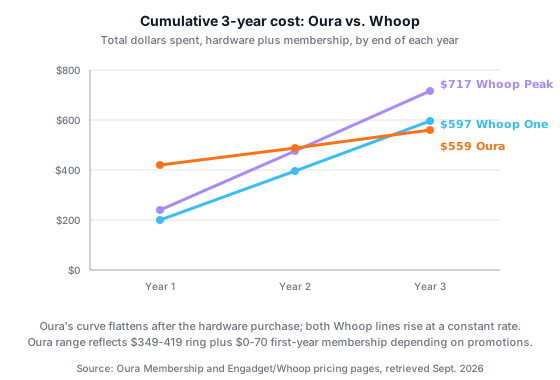
For a single buyer keeping the device 3 years, Oura's all-in cost is lower than Whoop's, but only after year one. Oura Ring 4 hardware runs $349-$499 depending on finish. The membership needed to unlock scores and trends costs $5.99/month or $69.99/year, with the first month free on signup (Oura Membership, retrieved 2026-09-06). Whoop bundles the device into the membership itself. One runs $199/year with the Whoop 5.0 device included. Peak runs $239/year and adds a stress monitor and healthspan metrics. Life runs $359/year and adds ECG-capable hardware and blood pressure tracking (Engadget, 2026, retrieved 2026-09-06).
- Oura (base ring, $349) — Year 1: $349 hardware, plus $0-69.99 membership depending on promotions. Years 2-3: $69.99/year membership only. 3-year total: roughly $489-$559.
- Whoop One — Year 1: $199, device included. Years 2-3: $199/year to keep the membership active. 3-year total: $597.
- Whoop Peak — Year 1: $239, device included. 3-year total: $717.
The gap isn't dramatic, but it's consistent. Oura's cost curve flattens hard after the hardware purchase. Whoop's recurring fee is the price of keeping the device functional at all, not just unlocking the app's insights. That distinction matters more than the raw numbers. Cancel Oura's membership and the ring still shows basic scores. Cancel Whoop and the strap stops reporting meaningfully, since the hardware was never sold as a standalone purchase.
The hidden cost on both sides is replacement hardware. Rings and straps both have finite battery life. Neither company publishes a guaranteed device lifespan past the warranty period. Budget for a hardware refresh sometime in year 3-4, regardless of which one you pick.
Which One Changed My Behavior and Which I Ignored
Personal data — pending measurement. This section will carry my own side-by-side log. It covers 60 days wearing an Oura Ring 4 and a Whoop 5.0 at the same time. It will track which device's morning number I actually checked, and which one I looked at once and stopped opening. It will include the daily open rate for each app. It will also note which score changed a same-day decision on training, caffeine timing, or bedtime, and how often. Not filled in yet: I publish it once the 60-day log is complete, not before.
The honest test for either device isn't the accuracy numbers above. It's whether the score changes what you do in the next hour. A Readiness Score that says "rest" only matters if you actually skip the workout. Track that compliance rate yourself for two weeks before assuming either device is "working." Check it objectively, not from memory, with one of the best sleep tracker options run against a no-wearable baseline.
Who Should Buy Which
You lift or train hard on a schedule: Choose Whoop. Strain and the day-over-day recovery percentage are built for programming decisions. The screenless strap also stays out of the way during grip-heavy lifts, unlike a bulky ring.
Sleep is the metric you're actually trying to fix: Choose Oura. It's the more accurate device on the exact signals sleep quality depends on: HRV, resting heart rate, and temperature trend. The ring also disappears at night in a way a wrist strap often doesn't for side sleepers.
You want the lowest 3-year cost and don't need training-load data: Choose Oura. The membership-only cost after year one is the cheaper steady state of the two.
You're testing whether a cold plunge or a supplement actually moves a number: Either device works, but pick the one you'll open every morning. A perfectly accurate device you stop checking after three weeks produces worse data than a slightly less accurate one you check daily. I ran this exact test while writing about cold plunge benefits.
If neither fits: track consistent sleep and wake times in a notes app for two weeks, at zero cost. That baseline tells you more than either device before you've built the habit of checking a score at all.
Can I use Oura and Whoop at the same time?
Yes. The validation study above is exactly what wearing both for a few weeks would replicate on your own data. It's a reasonable way to decide which score you trust more before committing long-term. Paying for both indefinitely is redundant once you've picked a winner for your use case.
Is Oura or Whoop better for sleep tracking specifically?
Oura, based on the current evidence. It scored higher concordance with the ECG-grade reference on both resting heart rate and HRV in the one study that tested both devices head-to-head. Its ring form factor also avoids some of the motion artifacts that affect wrist-worn optical sensors.
Does canceling the membership brick the device?
Not identically. Oura's ring keeps functioning with reduced insights and no trends if you stop paying (Oura Membership, retrieved 2026-09-06). Whoop's membership is bundled with the hardware itself. Canceling removes access to the data the strap collects, which functions closer to a rental than a one-time purchase.
Neither device is "better" in the abstract. Oura wins the accuracy data and the 3-year cost curve. Whoop wins the training-load use case it was purpose-built for. Pick based on the single number you'd actually act on tomorrow morning, not the longer feature list.
About this guide. Written by Nate Harmon, an operator and self-experimenter documenting personal protocols in biology for Peak Human Ops. Not a physician or a licensed adviser. Sources are tier 1-3 peer-reviewed studies, brand pricing pages, and reputable tech journalism, each linked inline with a retrieval date. This post may contain affiliate links, disclosed above the fold. How this site is written and corrected is set out in the editorial policy and the corrections log. Who is behind it is on the about page, and you can contact me directly.